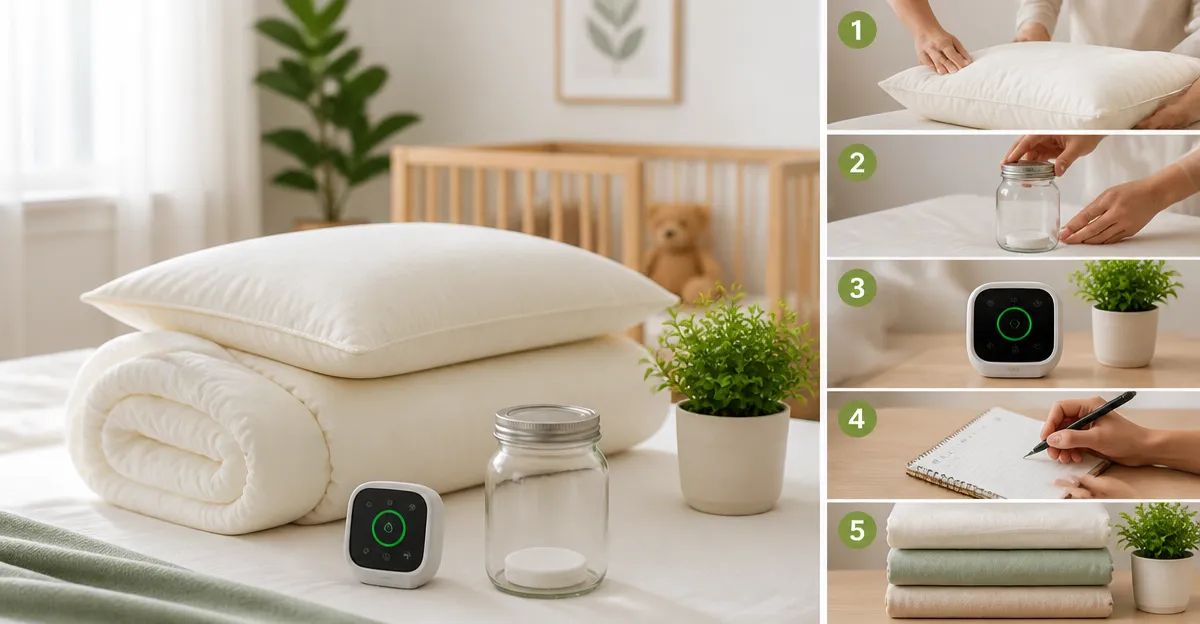
Introduction
Parents who prioritize a healthy sleep environment often wonder whether new bedding releases volatile organic compounds (VOCs) that could affect sensitive children. This guide explains how to evaluate low‑VOC bedding for off‑gassing using simple at‑home techniques. Readers will learn how to set up a controlled test, interpret odor cues, and optionally measure VOC levels with affordable sensors. By following these steps, one can make informed decisions about bedding purchases and protect family health without requiring professional equipment.
What You’ll Need
- New bedding items to test (sheets, mattress topper, comforter, or full set)
- Large airtight container or a resealable plastic bag (minimum 30 L)
- Digital hygrometer and thermometer (optional but helpful)
- Low‑cost VOC sensor or handheld air quality monitor (optional)
- Timer or stopwatch
- Notebook for recording observations
Below are a few recommended products that simplify the testing process. Each tool is selected for its relevance to a specific step, and the first mention of each product includes a direct Amazon link.
Step‑by‑Step Instructions
1. Prepare a Controlled Testing Space
Choose a quiet room with minimal airflow, such as a bedroom with windows closed and HVAC turned off. Place a digital hygrometer and thermometer inside the room to record temperature and humidity, as both factors influence VOC emission rates. A stable environment ensures that any detected odors or sensor readings are attributable to the bedding rather than external variables.
If you own a Bedsure Queen Sheet Set, lay the fitted sheet on a clean mattress to begin the test. The sheet’s bamboo‑derived rayon is marketed for cooling and low‑VOC properties, making it an ideal candidate for evaluation. Priced at $62.99, the set includes a deep‑pocket fitted sheet that stays securely in place, eliminating the need for additional fasteners that could interfere with the test.
2. Seal the Bedding in an Airtight Container
Place the bedding item inside a large resealable plastic bag or airtight container. If testing multiple items (e.g., sheets and a comforter), keep them separate to isolate each material’s off‑gassing profile. Seal the container tightly, removing as much air as possible. This mimics the storage conditions many consumers experience when unpacking new bedding.
For a mattress topper, consider the Niagara Sleep Solution Mattress Topper. Priced at $37.99 with a 4.4‑star rating from over 52,000 reviews, its ultra‑soft bamboo rayon construction offers a consistent baseline for VOC comparison. The deep pocket design fits mattresses up to 20 inches, allowing you to test the topper directly on the same surface used for the sheet set.
3. Allow an Initial Off‑Gassing Period
Leave the sealed items undisturbed for 24 hours. During this time, VOCs will accumulate inside the container. After the period, open the bag in the controlled testing space and note any immediate odors. A faint, chemical‑like scent may indicate the presence of residual VOCs, while a neutral or natural scent suggests low emissions.
When testing a comforter, the Bedsure Comforter Duvet Insert provides a useful reference. At $32.99 and a 4.7‑star rating from 76,000 reviews, this down‑alternative comforter is praised for its all‑season breathability, making it a relevant benchmark for low‑VOC performance.
4. Conduct a Sensory Odor Assessment
Position yourself approximately 30 cm (12 in) from the opened bedding and inhale gently. Record the intensity of any odor on a scale of 0 (no scent) to 5 (strong chemical odor). Repeat the assessment after 48 hours and again after one week to track how emissions diminish over time. Document the temperature and humidity readings alongside each observation, as higher humidity can amplify perceived odors.
If you own a full bedding set, the Velorose Queen Comforter Set offers an integrated test of multiple components (comforter, fitted sheet, flat sheet, and shams). Priced at $28.99 with a 4.6‑star rating from 825 reviews, the set’s microfiber fabric is marketed as low‑VOC and easy to care for, providing a comprehensive view of how a coordinated set behaves.
5. Optional: Measure VOC Concentrations with a Sensor
If you possess a handheld VOC sensor, place it at breathing height (about 1.5 m or 5 ft) in the testing room. Record the baseline reading before opening the bedding, then take measurements at 5‑minute intervals for the first 30 minutes after exposure. Compare the peak values to the baseline; a significant increase suggests higher off‑gassing.
While the guide does not recommend a specific sensor, many budget models (e.g., $30‑$50) provide sufficient accuracy for home use. Pairing sensor data with sensory assessment yields a more objective evaluation.
6. Evaluate Results and Decide
After completing the odor and optional sensor assessments, compare the results across all tested items. Bedding that consistently scores low on the odor scale and shows minimal VOC spikes is suitable for children and sensitive individuals. If an item registers high odor intensity or elevated VOC readings, consider airing it for additional days or returning it if the manufacturer offers a low‑VOC guarantee.
Remember that many low‑VOC products improve with continued airing. For example, the Bedsure sheet set often loses its initial scent after 48‑72 hours of ventilation, aligning with the manufacturer’s recommendation to wash in cold water before first use.
Tips & Pro Tips
- Perform the test in a room with stable temperature (20‑22 °C or 68‑72 °F) to avoid temperature‑driven VOC fluctuations.
- Use a fan to circulate air gently after opening the container; this accelerates off‑gassing and shortens the testing timeline.
- For households with infants, repeat the test after the first wash cycle, as detergents can further reduce residual chemicals.
- Document all observations in a notebook or digital spreadsheet for future reference when comparing new purchases.
- If a strong chemical odor persists beyond one week, contact the manufacturer and request VOC certification documentation.
Troubleshooting
- Persistent strong odor: Increase ventilation by opening windows for a few hours each day and re‑test after 48 hours.
- Sensor reads high VOCs but no odor: Some VOCs are odorless; rely on sensor data to make an informed decision.
- Container leaks air: Ensure the seal is tight; replace the bag with a rigid airtight container if needed.
Conclusion
Testing low‑VOC bedding for off‑gassing at home is straightforward when following a systematic approach. By preparing a controlled environment, sealing the bedding, allowing an initial off‑gassing period, conducting sensory and optional sensor assessments, and documenting results, parents can confidently select bedding that supports a healthy sleep environment for their children. The recommended products—Bedsure Queen Sheet Set, Niagara Sleep Solution Mattress Topper, Bedsure Comforter Duvet Insert, and Velorose Queen Comforter Set—serve as reliable tools to facilitate each step, though the method remains effective without any purchase.
Products Mentioned in This Guide
Frequently Asked Questions
How can I test new bedding for VOC off‑gassing at home?
Place the bedding in an airtight container for 24‑48 hours, then check for any noticeable odor or use a low‑cost VOC sensor to measure air quality.
What size container should I use for an accurate off‑gassing test?
A container or resealable bag of at least 30 L provides enough volume to capture emitted VOCs without diluting the sample.
Do I need a hygrometer or thermometer for the test?
They’re optional but help you record temperature and humidity, which can affect VOC emission rates.
How long should I wait before concluding that bedding is low‑VOC?
If no odor or sensor reading above background levels is detected after 48 hours, the bedding is likely low‑VOC.
Can I rely on a cheap handheld VOC sensor for precise results?
Handheld sensors give a good relative indication of off‑gassing, though they’re less precise than laboratory equipment.