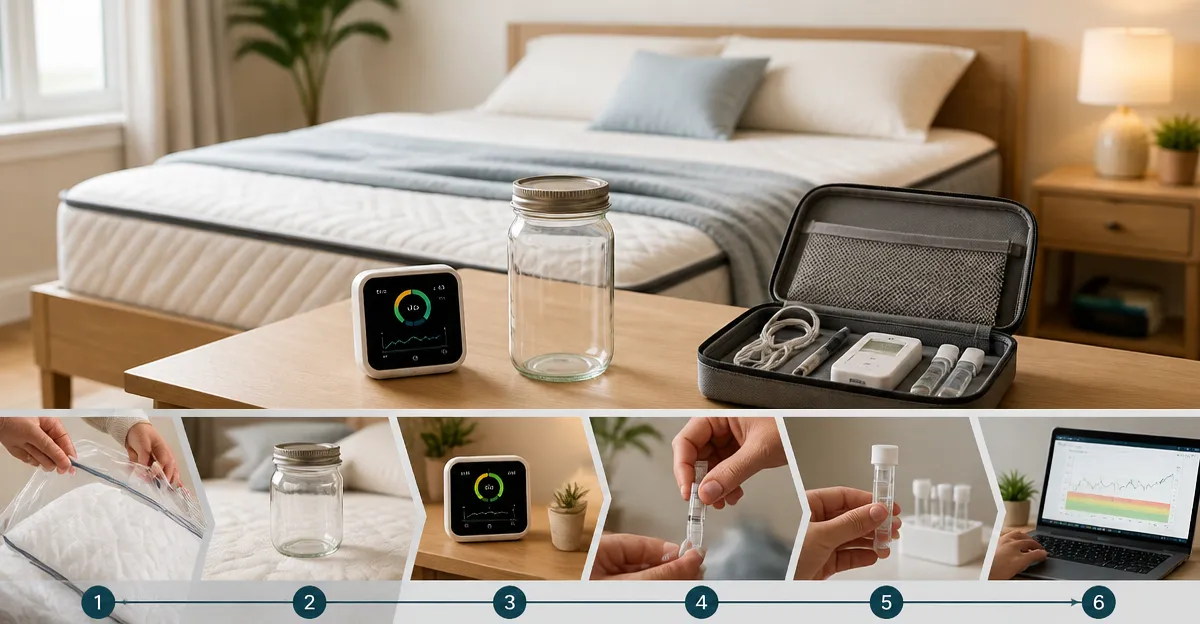
How to Measure VOCs in Mattresses and Bedding at Home: Affordable DIY Tests
Introduction
One will learn how to assess volatile organic compounds (VOCs) that may be emitted from mattresses and bedding using readily available tools. Understanding VOC levels is valuable because prolonged exposure can affect respiratory health, sleep quality, and overall well‑being. This guide presents a practical, cost‑effective approach that balances scientific rigor with household convenience. By the end of the article, one will be equipped to conduct reliable measurements, interpret results, and make informed decisions about ventilation or replacement.
What You’ll Need
- One reliable indoor air quality monitor capable of detecting TVOC (e.g., 16‑in‑1 Air Quality Monitor (7" Display)).
- A secondary sensor for temperature and humidity reference, such as the Aranet4 Home Air Quality Monitor.
- A notebook or digital spreadsheet for recording data.
- A quiet room with minimal airflow disturbances.
- A timer or smartphone alarm.
Step 1: Prepare the Testing Environment
One should select a bedroom or testing area where the mattress will remain undisturbed for at least thirty minutes. Close windows, doors, and HVAC vents to reduce external VOC interference, and ensure that no cleaning products are being used nearby. Place the Aranet4 Home Air Quality Monitor on a stable surface to record baseline temperature, humidity, and CO₂, which influence VOC emission rates. The Aranet4 offers an e‑ink display, four‑year battery life, and a rating of 4.7 / 5 from 1,849 reviewers, priced at $189.00, making it a dependable reference instrument.
Step 2: Calibrate the TVOC Sensor
Before measuring the mattress, one must allow the 16‑in‑1 Air Quality Monitor (7" Display) to warm up for five minutes in the same room. This device measures CO₂, PM2.5, PM10, HCHO, TVOC, temperature, humidity, and AQI, providing a comprehensive view of indoor air quality. Its large 7‑inch LED screen, three brightness settings, and seven distinct AQI alert buzzers aid clear interpretation. The monitor is priced at $75.98, holds a 4.3 / 5 rating from 337 reviews, and includes high‑precision external sensors with 0.001 accuracy, ensuring reliable TVOC readings.
Step 3: Position the Monitors Around the Mattress
Place the TVOC‑capable monitor at a height of approximately thirty centimeters above the mattress surface, directly above the head region where a sleeper spends the most time. Position the Aranet4 at the foot of the bed to capture ambient temperature and humidity that may affect VOC off‑gassing. Ensure both devices are stable and not touching the mattress fabric, as direct contact could skew sensor response. This arrangement creates a spatial profile that mirrors realistic breathing zones during sleep.
Step 4: Conduct the Measurement Cycle
- Start a timer for sixty minutes; this duration captures both initial off‑gassing and steady‑state emission.
- During the first ten minutes, record baseline TVOC, temperature, and humidity values from the monitors.
- After ten minutes, gently press the mattress surface with a clean hand to simulate normal movement, then continue recording for the remaining fifty minutes.
- At the end of the hour, note the peak TVOC value and the average reading over the last thirty minutes.
The 16‑in‑1 monitor logs up to ninety days of historical data via its free smartphone app, allowing one to export the CSV file for further analysis. Its color‑coded display and optional buzzer will alert if TVOC exceeds preset thresholds, providing immediate feedback.
Step 5: Interpret the Results and Take Action
One should compare the measured TVOC concentration against established indoor air quality guidelines, such as the World Health Organization’s recommendation of less than 0.3 mg m⁻³ for long‑term exposure. If the TVOC level exceeds this benchmark, consider increasing ventilation by opening windows for fifteen minutes each morning, or employing an air purifier with activated carbon filtration. For persistent high readings, the mattress may contain flame‑retardant chemicals or adhesives that off‑gas, and replacement could be advisable. Document the findings in the notebook, noting date, ambient conditions, and any remedial steps taken.
Tips & Pro Tips
- Perform the test at the same time of day each week to control for temperature fluctuations.
- Use the portable version of the 16‑in‑1 monitor (16‑in‑1 Portable Air Quality Monitor) if you need to assess mattresses in multiple rooms; its HD color screen and Type‑C fast charging make it convenient for on‑the‑go measurements.
- Allow the mattress to air out for at least twelve hours after receiving new bedding, as fresh sheets can temporarily elevate VOC levels.
- When possible, select low‑VOC certified mattress materials to reduce baseline emissions.
- Keep the monitoring devices away from direct sunlight, which can artificially increase sensor temperature and affect accuracy.
Troubleshooting
Problem: TVOC readings remain constantly at zero.
Solution: Verify that the sensor’s calibration mode is disabled and that the device firmware is up to date via the companion app. Also, ensure the sensor is not covered by dust or fabric.
Problem: Sudden spikes in TVOC after a cleaning session.
Solution: Pause the test, ventilate the room, and resume only after the spike has subsided, as cleaning agents can temporarily inflate VOC levels.
Conclusion
One now possesses a clear, repeatable method to measure VOCs emitted from mattresses and bedding using affordable, commercially available monitors. By following the structured steps, recording environmental variables, and interpreting results against health guidelines, one can make evidence‑based decisions to improve indoor air quality. Regular monitoring, combined with proper ventilation and low‑VOC product selection, will help maintain a healthier sleeping environment.
Products Mentioned in This Guide
Frequently Asked Questions
What is the simplest way to detect VOCs in a mattress at home?
Use a portable indoor air quality monitor that reports total VOC (TVOC) levels while the mattress is unwrapped in a well‑ventilated room.
Do I need a separate temperature and humidity sensor when measuring VOCs?
Yes, because temperature and humidity affect VOC emissions, and a reference sensor helps you interpret TVOC readings accurately.
How long should I run the monitor to get a reliable VOC reading?
Run the monitor for at least 30 minutes after the mattress has been placed in the test area to allow the sensor to stabilize.
Can I use a smartphone app instead of a dedicated VOC monitor?
Smartphone apps lack calibrated VOC sensors, so they are not reliable for quantitative measurements of mattress emissions.
What TVOC level indicates a mattress may be unsafe for sleep?
Readings consistently above 500 µg/m³ suggest elevated VOCs and may warrant increased ventilation or replacement.